18 June 2026
Company Liquidation in Malta
We assist in company liquidation in Malta, including for voluntary and compulsory liquidation. Our lawyers in Malta offer legal advice to those interested.

Company liquidation in Malta represents the procedure a company employs when concluding its business activities or when these activities can no longer continue by reason of insolvency. Company dissolution means the assessment of the Maltese company’s assets, payment of the creditors and the distribution of any remaining surplus between the shareholders. There are three ways of liquidating or winding up a company in Malta:
- the members’ voluntary liquidation;
- the creditors’ voluntary liquidation;
- court liquidation.
Our lawyers in Malta can provide you with information about the company liquidation proceedings.
Members’ voluntary dissolution in Malta
In order to start the liquidation procedure for a Maltese company, its directors must make a declaration through which the company engages to pay all its liabilities in 12 months. Voluntary dissolution is possible in the following cases:
- the duration of the company has expired;
- it is undergoing restructuration;
- the owner is retiring.
Member’s voluntary liquidation begins once the Maltese company’s shareholders pass a resolution and appoint a liquidator.
Creditors’ voluntary liquidation in Malta
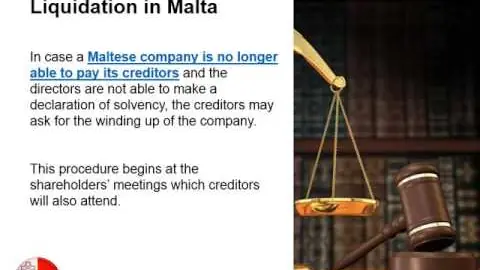
In case a Maltese company is no longer able to pay its creditors and the directors are not able to make a declaration of solvency, the creditors may ask for the winding up of the company. This procedure begins at the shareholders’ meetings which creditors will also attend. In this case, compared to the members’ voluntary liquidation, the creditor can appoint a liquidator of their own choice. You can obtain more information about creditors’ dissolution proceedings from our Maltese attorneys.
Court company liquidation in Malta
There are several reasons which can lead to company liquidation issued by a court in Malta. These are:
- the number of shareholders of the company decreases – less than two shareholders remain in the company for more than 6 months (this does not apply to single-member companies);
- the number of directors in the company decreases and remains so for a minimum period of 6 months;
- when the company’s Articles of Association specify that the company is created for a limited period of time, and that period has reached its end;
- when the court decides that there are sufficient motives for the company to be liquidated.
Our law firm in Malta can advise in case of company liquidation ordered by a court of justice.
Compulsory liquidation in Malta
Compulsory liquidation of a Maltese company begins with a court order following the application for dissolution of the members or creditors. The Maltese court will appoint an official receiver who will carry out the investigation and draft a report for the court. The receiver will assess all the Maltese company’s assets and liabilities and the cause of insolvency. The receiver will also become the company’s liquidator and carry out any remaining activities until the creditors appoint another person.
The video below presents the main ways of liquidating a company in Malta:
Documents related to winding up a company in Malta
The following documents must be filed with the Malta Business Registry when winding up a Maltese company:
- the minutes of the shareholders’ meeting where the liquidation was decided;
- the last financial statements and other accounting documents indicating the current economic situation of the company;
- several forms, among which the liquidation notice, the form through which the liquidator is appointed and a solvency declaration
- the liquidation notice which must be published in a daily newspaper.
Our lawyers in Malta can help you with the documents.
Liquidator role and duties
The liquidator is the person appointed to wind up the company in Malta. This person can be an accountant, lawyer, or any individual deemed suitable by the Malta Business Registry. Our Maltese lawyers are also certified to act as liquidators.
One of the main duties of a liquidator is to examine the company’s affairs and determine whether its debts can be paid within the period specified in the declaration of solvency. The liquidator will review the company’s financial situation to assess its ability to meet its obligations.
If the liquidator believes the company cannot pay its debts within the specified period, he/she must call a meeting of the creditors. During this meeting, he/she will present a statement of the company’s assets and liabilities. The meeting helps decide on the next steps for the process of closing a company in Malta. If it is determined that the company can’t pay its debts, the process will shift from the members’ voluntary dissolution to the creditors’ voluntary liquidation.
In case a member’s voluntary company liquidation in Malta takes longer than 12 months, the liquidator must call a general meeting of the company at the end of every 12 months. The liquidator will inform shareholders of any developments in winding up a company in Malta.
Our Maltese lawyerscan explain more about the roles and duties of the liquidator.
Tax considerations when closing a company in Malta
When closing a company in Malta, the liquidator must ensure any taxes are fully paid before distributing the assets to the shareholders. If the liquidator fails to settle these taxes, he/she can be held personally liable for the unpaid amounts. Any outstanding taxes and national insurance contributions must also be settled with the Malta Tax and Customs Administration (MTCA). Additionally, the company’s Permanent Establishment (PE) number needs to be deactivated.
The liquidation process can proceed even if the company has not yet received any tax refunds.
Before officially winding up a company in Malta, it is necessary to close all its bank accounts. Any remaining funds can be temporarily deposited into a liquidation account. Once the company is closed, these remaining funds can then be distributed to shareholders after a three-month waiting period. Our attorneys in Malta can help with closing or opening bank accounts.
Statistics about Maltese companies
While some entrepreneurs opt to close their companies in Malta, the country continues to experience growth in new company registrations, as demonstrated by the following statistics from 2023:
- The number of businesses in Malta increased by 2.4% from 2022, reaching a total of 140,540 businesses;
- Businesses employing up to nine people increased by 2.5%, compared to 2022;
- 57% of businesses consisted of self-employed individuals and partnerships;
- 39% of businesses were private companies;
- The largest proportion of businesses were in the professional, scientific, and technical activities sector, making up 13.6% of all businesses.
In addition to our liquidation services, we also assist in real estate matters. If you want to buy a house in Malta, you can call on the services of our local lawyers.
If you need assistance in liquidation cases, please contact our law firm in Malta. Our lawyers can also assist you set up an LLC in Malta with a minimum share capital of EUR 1,165.